Wondering, 'Why is my furnace blowing cold air?' Explore common issues like thermostat settings, clogged filters, and pilot light problems. Get answers now!
Is It Worth Repairing An Old Air Conditioner?
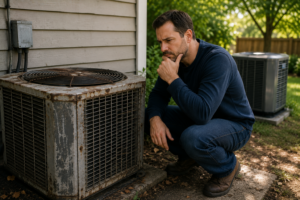 As summer temperatures rise, a failing air conditioner can be a major source of stress. When your older unit starts to falter, you face a critical decision. So, is it worth repairing an old air conditioner? The answer isn’t always straightforward, as it involves balancing immediate costs with long-term savings and reliability. This guide will walk you through the key factors to help you make an informed choice for your home and budget.
Key Factors to Consider: Repair vs. Replace
Before you make a call, it’s essential to evaluate your situation based on a few critical variables. For example, the age of your unit, the frequency of breakdowns, and the cost of the potential repair all play a significant role. Furthermore, considering the energy efficiency of your current system compared to newer models is crucial for understanding long-term expenses.
A minor fix on a relatively young unit might be a clear-cut decision. However, pouring money into an aging, inefficient system could be a poor investment. Therefore, a comprehensive assessment is your best first step.
What Are the Signs Your Old AC Needs More Than a Simple Fix?
Some AC problems are more serious than others, signaling that a replacement might be on the horizon. If you notice one or more of the following issues, a simple repair may not be the most cost-effective solution. Consequently, you should pay close attention to your system’s performance.
- Frequent Breakdowns: If you’re calling for repairs multiple times a year, the cumulative costs can quickly add up. This often indicates a systemic failure rather than an isolated problem.
- Age of the Unit: Most air conditioners have a lifespan of 12-15 years. If your unit is in this range or older, investing in a major repair is often not advisable as other components are likely to fail soon.
- Rising Energy Bills: A sudden or steady increase in your cooling costs suggests your AC is losing efficiency. As parts wear out, the system has to work harder to cool your home, consuming more electricity.
- Strange Noises or Odors: Loud grinding, squealing, or banging sounds can point to serious mechanical failures. Similarly, musty or burning smells can indicate issues with wiring or mold growth within the unit.
- R-22 Refrigerant: If your AC unit was manufactured before 2010, it likely uses R-22 refrigerant, which is being phased out due to environmental concerns. As a result, its cost has skyrocketed, making a refrigerant leak an extremely expensive repair.
The Financial Breakdown: Comparing Repair Costs to Replacement Costs
Ultimately, the decision often comes down to money. You need to weigh the short-term expense of a repair against the long-term investment of a new system. Importantly, a new system comes with a new warranty and improved efficiency that can save you money over time.
The 50% Rule: A Guideline for HVAC Decisions
A widely used guideline in the HVAC industry is the “50% rule.” This rule suggests that if the cost of a repair is more than 50% of the value of a new system, you should opt for replacement. For instance, spending $1,500 to fix a 14-year-old unit that would cost $5,000 to replace is generally not a wise financial move. This simple calculation can help you understand the full cost of ownership and avoid sinking money into a failing system.
Considering SEER Ratings and Energy Efficiency
Modern air conditioners are significantly more energy-efficient than their older counterparts. Efficiency is measured by the Seasonal Energy Efficiency Ratio (SEER). While an old unit might have a SEER rating of 10 or less, new models are required by law to have a minimum SEER of 14 or 15, with high-efficiency models reaching 20 or more. According to the U.S. Department of Energy, upgrading can reduce your energy consumption for cooling by 20% to 50%. This is a critical factor when you ask, is it worth repairing an old air conditioner? The long-term energy savings from a new unit can often offset the higher initial investment. For more details, you can review official information on central air conditioning standards.
Why is it worth repairing an old air conditioner in some cases?
Despite the benefits of replacement, there are situations where a repair is the logical choice. If your air conditioner is less than 10 years old and has been generally reliable, a one-off repair makes perfect sense. Additionally, if the required fix is minor and inexpensive—such as replacing a capacitor or a fan motor—it’s much more economical to repair it. A qualified technician from a professional AC repair service can diagnose the issue accurately and tell you if it’s a simple fix or a sign of a larger problem. In these scenarios, a repair extends the life of your current investment without a major capital outlay.
Final Thoughts: Making the Right Choice for Your Home
Deciding whether is it worth repairing an old air conditioner? requires a careful evaluation of its age, repair history, performance, and the cost of the proposed fix. While a new system offers better efficiency and reliability, a timely repair can be a smart, budget-friendly choice for a younger, well-maintained unit. If you’re facing frequent breakdowns, high energy bills, and repair costs approaching 50% of a replacement, investing in one of today’s modern air conditioning systems is likely the better long-term solution. For a clear path forward, the best step is to get an expert opinion. Contact us for a professional evaluation to get a precise diagnosis and an honest recommendation tailored to your specific situation.
Related Posts